
Low Glycemic Index Foods: A Gujarati Kitchen Guide to Steady Blood Sugar

Key takeaway: You don't need a new diet to keep your sugar steady. Choose more whole dals, millets and vegetables, keep refined and sugary foods small, and always pair your rotli or rice with protein and fibre.
When someone with diabetes, pre-diabetes or PCOD comes to me, we rarely start with a long list of "don'ts". We start with one simple question: how fast does this food turn into sugar in your blood? The glycemic index answers exactly that. The good news is that an Indian kitchen, and a Gujarati one in particular, is already full of low glycemic index foods that are gentle on blood sugar.
What is the glycemic index, in plain words?
The glycemic index (GI) is a score from 0 to 100. It shows how quickly a food containing carbohydrate raises your blood sugar compared with pure glucose.
Low GI (55 or less): sugar enters the blood slowly. You stay full longer.
Medium GI (56 to 69): a moderate rise.
High GI (70 or more): sugar rises fast and drops fast, and you feel hungry again soon.
Portion matters too: glycemic load
A low GI food eaten in a very large amount can still raise sugar a lot. Experts call this the glycemic load (GL): it looks at both the type of carbohydrate and how much of it you eat. So a big plate of even "healthy" khichdi is still a big plate.
GI also changes with cooking and ripeness. Well-cooked, soft or mashed foods usually raise sugar faster than whole, firmer foods. A ripe banana raises sugar faster than a less ripe one. You don't need to memorise numbers; just learn which way your everyday foods lean.
Low GI foods already in your Gujarati kitchen
Dals and pulses: moong, masoor, chana, tuver, chora, rajma, chole and sprouts (fangavela mag).
Millets and whole grains: bajra, jowar, nagli (ragi), kodri, broken wheat (fada), rolled oats.
Vegetables: methi, palak, dudhi, turiya, galka, tindora, guvar, cabbage, cauliflower, lilva and beans.
Fruits (one at a time): guava, apple, pear, orange, jamun and papaya in a small katori.
Dairy: curd, chaas and milk without added sugar.
Nuts and seeds: a small handful of peanuts, almonds, walnuts, roasted chana or til.
Foods to keep small or have less often
These foods tend to raise sugar quickly. You don't have to ban them, but keep the portion small and don't eat them alone.
White bread, maida khari, nankhatai and biscuits.
Sugar, jaggery, sweet chhundo, murabba and mithai.
Large portions of white rice, or potato-heavy dishes like batata poha and batata vada.
Fruit juice, packaged juices and sweetened drinks.
Deep-fried farsan made with maida or besan, like fafda and sev, eaten in big amounts.
6 simple swaps for everyday Gujarati meals
Breakfast poha: cut the potato, add peas, vegetables and a few peanuts, and have a bowl of curd with it.
Thepla: make them with methi and bajra or jowar flour; have 2 with curd, not 4 with chhundo.
Rice: a small katori of rice with plenty of dal and sabzi, or try kodri or mixed-millet khichdi with vegetables.
Tea-time snack: swap biscuits or khari for roasted chana, makhana or a bowl of sprouts.
Fruit juice: eat the whole fruit instead. The fibre slows the sugar rise.
Farsan: choose steamed muthiya or khaman in a small portion instead of fried fafda.
How you eat matters as much as what you eat
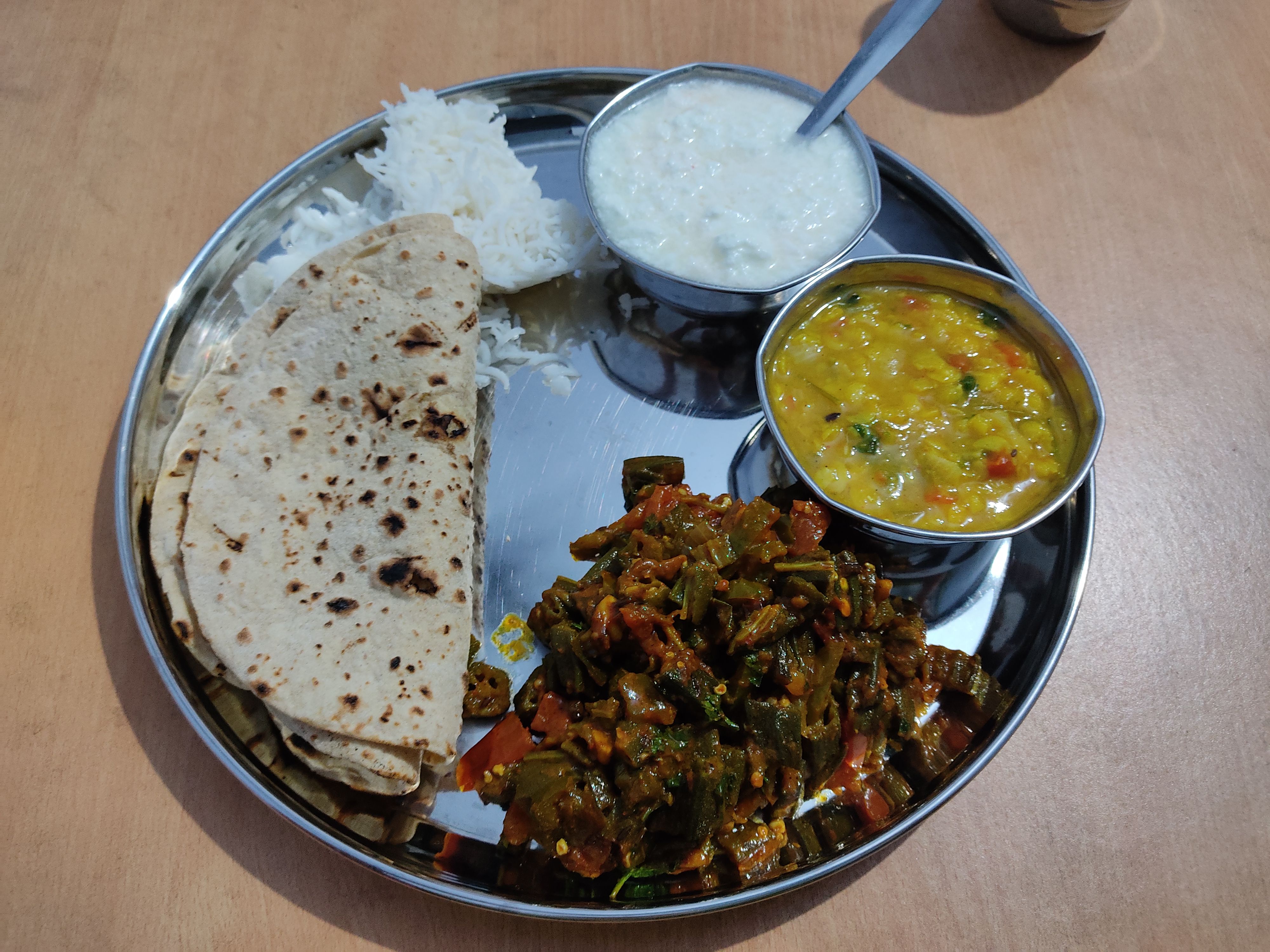
Build a balanced plate. Fill half the plate with sabzi and salad, a quarter with whole grains (rotli, bajra rotla, small rice), and a quarter with protein (dal, curd, paneer, sprouts).
Never eat carbohydrate alone. Pair rotli or rice with dal, sabzi and curd. Protein and fibre slow down the sugar rise.
Try vegetables and dal first. In a small study of people with type 2 diabetes, eating vegetables and protein before the carbohydrate part of the meal led to a lower sugar rise after the meal.
Keep meal times regular. Long gaps followed by one heavy meal cause bigger swings.
Walk for 10 to 15 minutes after meals if your doctor says it is safe for you.
A sample low GI Gujarati day
Early morning: water and a few soaked almonds or walnuts.
Breakfast: vegetable poha (no potato) with curd, or 2 methi-bajra thepla with curd.
Mid-morning: 1 guava or 1 orange.
Lunch: kachumber first, then dal, a green sabzi, 1 to 2 rotlis or a bajra rotla, and chaas.
Evening: plain tea with roasted chana or a bowl of sprouts.
Dinner: fangavela mag (recipe below) with 1 jowar rotli and sabzi, or vegetable moong dal khichdi with curd.
Portions are different for every person. They depend on your weight, activity, reports and medicines.
Recipe: Fangavela mag nu shaak (sprouted moong, Gujarati style)
Serves 2 · Ready in 20 minutes (after sprouting)
Ingredients
1 cup sprouted moong
1 small onion and 1 tomato, chopped
1 tsp oil, ½ tsp rai (mustard seeds), a pinch of hing
¼ tsp haldi, ½ tsp dhana-jeeru powder, chilli and salt to taste
A squeeze of lemon and fresh coriander
Method
Heat the oil, add rai and hing, then the onion. Cook for 2 minutes.
Add tomato, haldi, dhana-jeeru, chilli and salt. Cook till soft.
Add the sprouts and ½ cup water. Cover and cook for 8 to 10 minutes, till just soft but still holding their shape.
Finish with lemon and coriander.
Why it works: sprouted moong gives protein and fibre, so it keeps you full and helps the meal raise sugar more gently. Have it with 1 rotli or bajra rotla and a bowl of curd for a balanced meal.
If you have diabetes, PCOD or take medicines
These tips are general guidance for healthy adults and are not a treatment. If you have diabetes, PCOD, thyroid, kidney problems or are pregnant, please consult a qualified dietitian or doctor before changing your diet. If you take medicines or insulin for sugar, food changes can change your readings, so never change or stop a medicine on your own. Check your sugar as your doctor advises.
Want to see how this fits into a full day? Read our diabetes diet chart for Indian vegetarians or the PCOD diet plan for Indian vegetarians.
Frequently asked questions
Is brown rice better than white rice for blood sugar?
Brown rice has more fibre, so it usually raises sugar a little more slowly than white rice. But portion matters most. A small katori of either, eaten with plenty of dal and sabzi, is better than a large plate of rice alone.
Are millets like bajra and jowar good for diabetes?
Whole millets are a good source of fibre and fit well in a diabetes-friendly plate. They still contain carbohydrate, so keep the portion sensible: for example, 1 bajra rotla instead of 3, with sabzi and dal.
Is jaggery (gol) better than sugar?
No. Jaggery is still a form of added sugar and raises blood sugar much like sugar does. Both should be kept small.
Can I eat fruit if my sugar is high?
Yes, most people can. Choose a whole fruit, not juice, in a small portion such as 1 guava or 1 orange, and have it as a snack rather than right after a heavy meal. Check your readings and follow your doctor's advice.
About the author
Dt. Binjal Shah is the founder of Nutriotherapy, an online diet clinic based in Ahmedabad. She holds an M.Sc. in Food Science & Nutrition, is a certified diabetic educator and has over 11 years of experience helping families with weight loss, weight gain, PCOD, diabetes, thyroid, blood pressure and heart health through simple, home-style Indian food.
Get a plan made for your kitchen
Start with our free Gujarati thali guide, or book a one-to-one online session with Dt. Binjal Shah. Your first session is ₹1,200 with code FIRSTCONSULTATION, and you get a plan built around your reports, your routine and the food you already cook.



Comments